
My life in Portugal is generally idyllic but, as weird as it may seem, my biggest bugbears are understanding my actual address and receiving online deliveries!
The problem is that neither the street address or the postal code indicate our exact physical location.
- Entering our street address in Google Maps leads to shop about 90 metres away from our apartment!
- And our postal code covers an area of about 1 000 square metres. As area which includes a multitude of houses, churches, businesses, and apartment blocks!
So what's the solution?
I understand that these problems are a legacy of the past, but with available technology, there is a cheap and easy solution.
Adopt what3words as the address standard in Portugal.
However, before considering what3words is as a solution, let's look at some examples of our address and location problems.
Postal Code and Address problems
Below in the Google Maps picture of our postcode (3840-411) shown in the light-shaded section. It is about fifty metres wide and two hundred metres long and covers many properties along both sides of the N109 road. So as a direct delivery location the post code is useless.
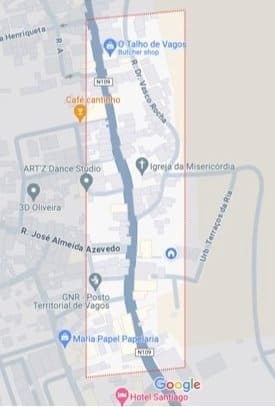
Vagos Portugal 3840-411
In addition many buildings have no displayed numbers or names.
And to add to the confusion, as can be seen from the following picture from Google Maps, street numbers appear random or non-existent.
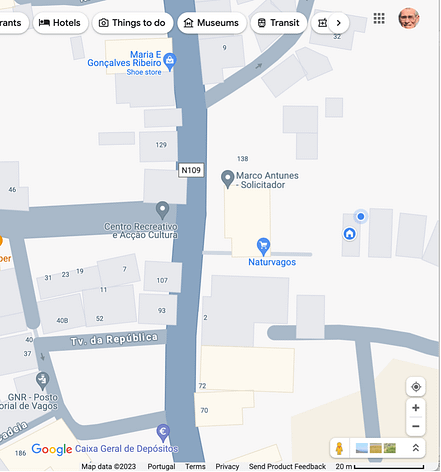
Faced with these issues, trying to make sense of our address, and then explaining it to a delivery driver is time-consuming, inefficient, and frustrating.
So, what is what3words?
what3words is a system that has divided the world into fifty-seven trillion 3-meter squares, each with a unique three-word address.
So, with this address, you can locate any 3-metre by 3-metre position anywhere in the world – even in the middle of the Arctic or the sea!
This system is invaluable for countries with remote areas and sizeable postal code areas because it provides an accurate and reliable way to identify a precise location.
In remote areas, traditional street addresses may not exist. In urban areas, postal codes may be too imprecise to be helpful.
Why use what3words?
what3words provides a simple and easy-to-use alternative to help people in these areas to receive mail, get emergency services, and receive deliveries. For example:
In addition to being useful in remote areas, what3words is also helpful in urban areas where the traditional street addresses are non-existent or meaningless.
Finally it can be used for simply finding a friend or family on a crowded beach, in a large park, recreation area or stadium. Where the what3words address leads to the exact location.
Benefits of what3words:
Multilingual:
Available in over 53 languages, what3words addresses have the same simple format worldwide.
This language flexibility means, for example, you can explore Tokyo using addresses in Portuguese.
A what3words address can be switched instantly into any supported language and even looked up in one language and shared in another.
Accurate and reliable:
Every 3-meter square worldwide has a unique address, and built-in error prevention helps users spot and correct input mistakes.
The system is fixed and will never change so that what3words can be used reliably offline without a data connection.
Easy to integrate:
what3words addresses can be connected to GPS coordinates, providing a human-friendly way to give accurate location information to systems and platforms.
This connection provides an invaluable service to every organisation that needs an accurate address, from e-commerce checkouts and navigation apps to emergency command and control systems.
Easy to remember and communicate:
The addresses are easy to remember and communicate over the phone or radio. They're also quicker and easier to type than a regular street address.
They're designed for speech recognition technology, making them easy to input correctly into voice-enabled devices or vehicles
In Conclusion
The technology is being built into the official postal system in countries like Mongolia, Ivory Coast and Nigeria to overcome their inherent address and postal code problems.
In the UK, what3words is accepted by over 80% of UK emergency services. While some services in other countries use it, use is not widespread outside of the UK.
Mercedes, an investor, is incorporating what3words navigation into its cars. Recently, what3words announced a new investment from SAIC Motor, China's largest carmaker, and Alpine Electronics, which makes car radios and navigation systems.
Other earlier investors include German train operator Deutsche Bahn, Dubai-based shipping firm Aramex, and Intel Capital. Navigation companies like TomTom and Sygic are customers.
Shouldn't Portugal be the next country?
Or France, where I've recently heard that is certain areas they are going through the process of naming streets, then they will have to number them. This seems to be a total waste of time and money when there is a readily available solution!!
I now include my what3 words address in my email signature and use it with all of my online purchase deliveries
In the comments below, have your say on any hassles you have with your address and whether you think Portugal should be one of the next countries to adopt what3words for emergency services and postal deliveries.
I just learned about What 3 Words on my latest trip to London and absolutely loved it. Could be an amazing addition to the Portuguese postal service!